
Brakes
How to Tell When Your Brake Pads Are Done
Pads give you plenty of warning before they run out. Most of the warning is a noise, and the rest of it you can see through the wheel with a flashlight.
Brakes
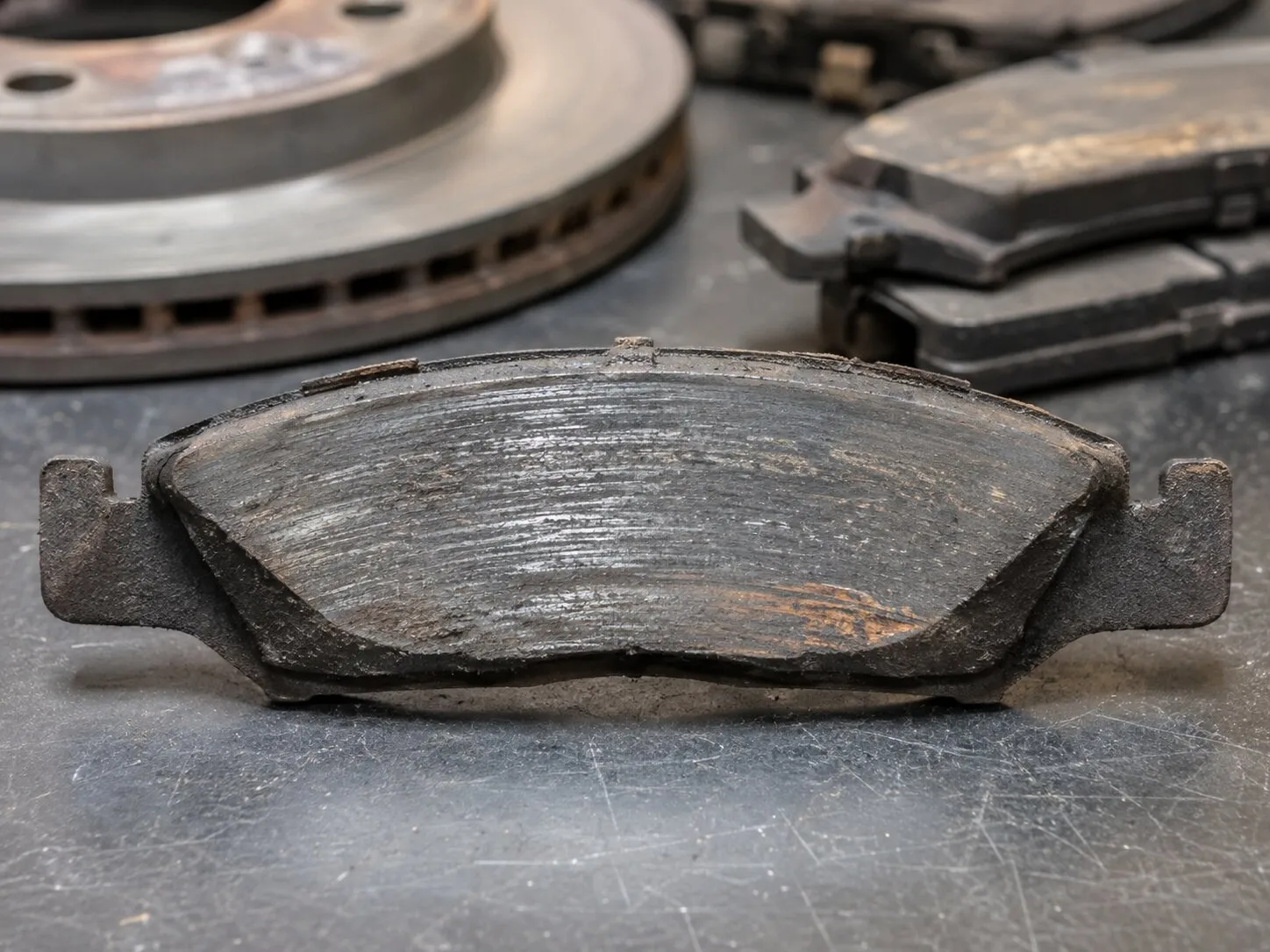
Brake pads wear out on a schedule nobody can predict, which is why every answer to how long they last comes with a range wide enough to be useless. Two identical cars leaving the same dealership can be 40,000 miles apart when they need their first set. The car in stop-and-go traffic on US-19 is doing several times the braking of the one that spends its life on the interstate, and pads only wear when they are working.
So mileage tells you when to start looking. Three other things tell you what you have left.
Thickness is the real measurement
A new pad carries somewhere around 10 to 12mm of friction material on the backing plate, depending on the manufacturer. That figure comes down in a straight line as you drive.
At about 3mm, the pad is at the end of its useful life. Most manufacturers set the replacement point somewhere in that region, and the metal wear indicator tab is positioned to start touching the rotor and squealing around there. Below 3mm you are into the last of the material, and at zero the steel backing plate is riding directly on the rotor face.
The gap between those two states is the whole cost difference in a brake job. Pads caught at 3mm are a pad replacement. Pads run to zero take the rotor with them, and sometimes the caliper too.
How to check yours in five minutes
Park on level ground, turn the wheels to full lock, and look through the spokes with a flashlight. You are looking at the outer pad where it sits against the rotor, and you are comparing the thickness of the friction material to the steel plate behind it. A pad worn down to about the thickness of that plate is close to done.
Two warnings on that check. The inner pad often wears faster than the outer one and you cannot see it from outside the wheel, so a healthy-looking outer pad is not proof. And a car with a seized caliper slide pin can have one pad at zero and the other near new on the same wheel. Salt air near the Gulf seizes slide pins early, which makes uneven wear more common here than it is inland.
For a real answer, the wheel comes off and both pads get measured. That takes a few minutes per corner.
The noises, decoded
A steady high squeal that rises with speed and stops when you brake. That is the wear indicator dragging on the rotor. It is a designed warning, and it means you are near the replacement point. Book the job.
A squeal on the first stop or two of a damp morning, then nothing. Surface rust on the rotor from sitting overnight. Normal, and it clears itself.
Grinding, growling, or a sound like gravel under the wheel. Metal on metal. The friction material is gone. Stopping distance is longer than you think it is, and every stop is cutting a groove into the rotor. Stop driving on it.
A single clunk on the first stop after you set off. Loose or missing hardware, worn slide pins, or pads moving in the bracket. Not urgent this second, but it is a brake component doing something it should not.
A shudder or a pulse through the pedal on a long stop. Uneven rotor thickness, not warping. The word warped has stuck to this fault for decades and it sends people to buy parts they do not need. Our mobile brake repair page covers what is happening instead and when a rotor can be saved.
What the pedal tells you
A pedal that sits lower than it used to, or sinks slowly while you hold it at a light, is a hydraulic symptom rather than a pad symptom. That is a master cylinder or a leak, and it is more urgent than worn pads.
A car that pulls to one side under braking is telling you the two sides are not doing equal work. A stuck caliper, a collapsed flexible hose or a seized slide pin all do that, and all of them wear one set of pads out early.
Brake fluid matters here too. It absorbs moisture out of the air over the years, and wet fluid boils at a lower temperature. On a long descent or in heavy traffic that shows up as a pedal that goes soft when it is hot. Fluid is worth checking whenever the pads are.
Why pads get replaced in pairs
Pads go in as an axle set, both front wheels or both rear wheels together. Replacing one side leaves the car braking harder on the fresh side, which is exactly the pull described above. Rotors follow the same rule when they need doing.
Front pads generally wear faster than rear ones, because weight transfers forward under braking and the front brakes do most of the work. On many cars the fronts get replaced twice for every rear set.
The cost of waiting
Pads are the cheapest part of a brake system and the only one designed to be consumed. Everything they protect costs more. Run them to the backing plate and the rotor gets scored past its minimum thickness, so a pad job becomes pads and rotors. Keep going and the pad material can separate, the caliper piston can overextend, and the repair moves again.
None of that is a reason to panic at the first squeal. It is a reason to have someone measure the pads within a week of hearing one.
Get a number, not an opinion
If the car is making a noise you cannot place, the useful next step is a measurement. We pull a wheel at your house or your office lot, measure pad material and rotor thickness, check the hardware and the fluid, and give you the figures. Estimates are free, and you decide what happens next.
Brake service that comes to you
Get the pads measured in your driveway
We pull a wheel, measure the pad material and the rotor, check the caliper hardware, and tell you what the car needs before anything gets replaced. Brakes travel well, so the whole job happens where the car is parked.
See mobile brake repairQuestions
Asked at the curb
How long do brake pads last?
Anywhere from around 25,000 to 70,000 miles on a typical car, and the spread is wider than that at both ends. Traffic, weight, pad material and how early you lift off the accelerator all move it. Mileage is a prompt to look, not an answer. Thickness is the answer.
Is it safe to drive with grinding brakes?
No. Grinding means the friction material is gone and the pad backing plate is cutting into the rotor. Stopping distance is longer, the damage gets worse with every stop, and a job that needed pads now needs rotors as well. Get it looked at before you drive it further.
Do rotors have to be replaced with the pads?
Not always. Every rotor carries a minimum thickness stamped or cast into it, and a rotor above that figure with a clean surface can stay. A rotor that is under spec, cracked or deeply scored gets replaced. We measure rather than assume, and we tell you the number we measured.
Can brake pads be replaced at my house?
Yes. Pads, rotors and caliper hardware are all driveway work, given level ground and room to get a jack under the car. We carry what the job needs and take the old parts away with us.
Book a brake inspection
Tell us the vehicle and the noise it makes. We measure the pads and rotors at your address, and the estimate costs nothing.
Monday to Friday, 8:00 AM to 5:00 PM